Showing posts with label Culture. Show all posts

Thursday, July 28, 2011

10 monsters that inspire dread


#10 - Cockatrice

10

The Cockatrice can cause death with a single glance. Reports indicate that anything catching sight of the lethal bird’s eyes is turned instantly to stone. Just as deadly is their poisonous saliva, which can fell even an elephant. Also known as a Basilisk, a Cockatrice has the head and feet of a cockerel and the tail of a serpent. The Cockatrice is believed to be the product of a seven-year-old cockerel’s egg, laid during a full moon, and then hatched for nine years by a serpent or toad. There are a few ways to protect oneself from a Cockatrice. One is to carry something reflective – like a mirror – and turn the creature’s gaze back on it. Another is to keep either a weasel or a cockerel nearby. The weasel is said to be the mortal enemy of the Cockatrice, While the crowing of the cockerel is even more effective as it causes the Cockatrice to have fatal fits and ultimately thrash itself to death.

#9 - Manticore
9

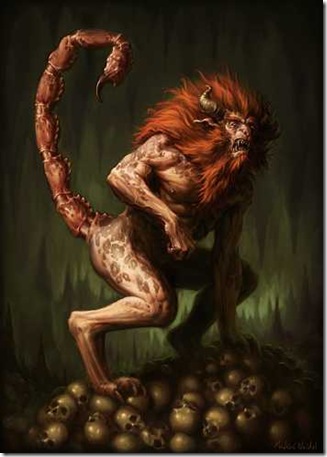
The manticore is a legendary creature similar to the Egyptian sphinx. It has the body of a red lion, a human head with three rows of sharp teeth (like a shark), and a trumpet-like voice. Other aspects of the creature vary from story to story. It may be horned, winged or both. The tail is that of either a dragon or a scorpion, and it may shoot poisonous spines to either paralyze or kill its victims. It devours its prey whole. It leaves no clothes, bones or possessions of the prey behind. The creature’s feet may be those of a dragon, but are most often described as the paws of a lion. Its size ranges from the size of a lion to the size of a horse. It is also mistaken as a bearded man when seen from a distance – a deception which makes it easy to fall victim to the creature.

#8 - Kelpie

8

The kelpie is a supernatural water horse from Celtic folklore, that is believed to haunt the rivers and lochs of Scotland and Ireland. The horse’s appearance is strong, powerful and breathtaking. Its hide was supposed to be black (though in some stories it was white), and it will appear to be a lost pony, but can be identified by its constantly dripping mane. Its skin is like that of a seal, smooth, but is as cold as death when touched. Water horses are known to transform into beautiful women to lure men into their traps. The water horse is a common form of the kelpie, said to lure humans, especially children, into the water to drown and eat them. It performs this act by encouraging children to ride on its back. Once its victims fall into its trap, the kelpie’s skin becomes adhesive and it bears them into the river, dragging them to the bottom of the water and devouring them—except the heart or liver.

#7 - Soucouyant

7

Not only is the soucouyant scary – it is probably the most bizarre entry here. The soucouyant in Dominica, Trinidadian and Guadeloupean folklore, is a kind of vampire. The Soucouyant lives by day as an old woman at the end of the village. By night, however, she strips off her wrinkled skin, puts it in a mortar, and flies in the shape of a fireball through the darkness, looking for a victim. Still in the shape of a fireball, the soucouyant enters the home of her victim through the keyhole, or any crack or crevice. Soucouyants suck the blood of people from their arms, legs and other soft parts, while they sleep. If the soucouyant draws out too much blood from her victim, it is believed that the victim will die and become a soucouyant herself, or else perish entirely, leaving her killer to assume her skin. The soucouyant practices witchcraft, voodoo and black magic. Soucouyants trade the blood of their victims for evil powers with Bazil, the demon who resides in the silk cotton tree.

#6 - Umibōzu

6

Umibōzu is a spirit in Japanese folklore. The Umibōzu is said to live in the ocean and capsize the ship of anyone who dares speak to it. This spirit’s name, which combines the character for “sea” with the character of “Buddhist monk,” is possibly related to the fact that the Umibōzu is said to have a large, round head, resembling the shaven heads of Buddhist monks. Alternatively, they are enormous Yōkai (spectres) that appear to shipwreck victims and fishermen. They are believed to be drowned priests, exhibit the shaven head and typically appears to be praying. It is usually reported as having a grey, cloud-like torso and serpentine limbs. As you can see from the image above, this is not a creature you want to bump into in the middle of the night.


#5 - Hidebehind

5

A hidebehind is a nocturnal fearsome critter from American folklore that preys upon humans that wander the woods, and was credited for the disappearances of early colonial loggers when they failed to return to camp. As its name suggests, the hidebehind is noted for its ability to conceal itself. When an observer attempts to look directly at it, the creature hides again behind an object or the observer, and therefore can’t be directly seen; a feat it accomplishes by sucking in its stomach to a point where it is so slender that it can easily cover itself behind the trunk of any tree. The hidebehind uses this ability to stalk human prey without being observed, and to attack without warning. Their victims, including lumberjacks who frequent the forests, are dragged back to the creature’s lair to be devoured. The creature subsists chiefly upon the intestines of its victim. Tasty.

#4 - Bakeneko

4

Cats are meant to be furry and cute – but not when it is five feet high and shoots fireballs! A bakeneko (“monster-cat”) is, in Japanese folklore, a cat with supernatural abilities akin to those of the fox or raccoon dog. A cat may become a bakeneko in a number of ways: it may reach a certain age, be kept for a certain number of years, grow to a certain size, or be allowed to keep a long tail. A bakeneko is a cat that gains paranormal powers after certain circumstances. They also have the ability to eat (bigger or smaller) anything in its way, no matter what it is. Poison is its main food. A bakeneko will haunt any household it is kept in, creating ghostly fireballs, menacing sleepers, walking on its hind legs, changing its shape into that of a human, and even devouring its own mistress in order to shapeshift and take her place. When it is finally killed, its body may be as much as five feet in length. It also poses a danger if allowed into a room with a fresh corpse; a cat is believed to be capable of reanimating a body by jumping over it.

#3 - Draugr

3

A draugr is an undead creature from Norse mythology. Draugar were believed to live in the graves of dead Vikings, being the body of the dead. As the graves of important men often contained a good amount of wealth, the draugr jealously guards his treasures, even after death. Draugar possess superhuman strength, can increase their size at will, and carry the unmistakable stench of decay. The draugr’s ability to increase its size also increased its weight, and the body of the draugr was described as being extremely heavy. Thorolf of Eyrbyggja Saga was “uncorrupted, and with an ugly look about him… swollen to the size of an ox,” and his body was so heavy that it could not be raised without levers. In folklore the draugar slay their victims through various methods including crushing them with their enlarged forms, devouring their flesh, devouring them whole in their enlarged forms, indirectly killing them by driving them mad, and drinking their blood. Animals feeding near the grave of a draugr may be driven mad by the creature’s influence.

#2 - Monstrous Races

2

Pliny (in his Natural History, 77AD) gives us the first accounts of monstrous races in his attempt to describe the various unknown peoples of foreign lands. Some of the races he describes are hairy choromandae, which make a terrifying gnashing noise, half-beasts and half men created by the gods to terrify men for their amusement, and perhaps most horrifyingly a race of creatures who feed exclusively on the milk of dog-headed men (cynocephalae). In medieval history we find men with chests in their heads, and gigantic men who roam about on one leg, but prefer to lie on their back using their giant foot to protect them from the sun (sciapods). Pictured above is a weird mix of a man with a head in his chest, mixed with a bird.

#1 - Tiamat

1

We are all familiar with dragons from various historical tales and myths, but Tiamat really takes the cake for inspiring terror. Tiamat comes to us from Babylonian mythology. She is often wrongly described as being a sea-serpent or dragon, but it is far worse than that. First, here is a description: “[Tiamat had] a tail, a thigh, “lower parts” (which shake together), a belly, an udder, ribs, a neck, a head, a skull, eyes, nostrils, a mouth, and lips. She has insides (possibly “entrails”), a heart, arteries, and blood.” She was made up of such a jumble of things that she truly was a creature of chaos. But it gets worse. Tiamat was so horrifying, so monstrous, and so dread-inspiring because, from her bizarre pseudo-human cum cryptozoological body, she gave birth to dragons, scorpion-men, merpeople (yes, that is a real word), and countless other horrifying things. The Tiamat myth says that she was eventually killed by the god Marduk, who then split her body in two forming heaven and earth.

read more...

Tuesday, September 14, 2010

7 Ways To Indulge In the Seven Deadly Sins


Disclaimer: This list is just for fun and not of a religious nature. We all indulge in guilty pleasures from time to time, and we all find ways to not feel guilty about them. Here is a list of ways to heavily indulge in the 7 guiltiest of pleasures: the Seven Deadly Sins.


#1 - Wrath

Destroy a Car

1

Who doesn’t like taking their anger out on inanimate objects from time to time? There was a “Smash for Cash” fundraising event held recently, where people donated a few dollars to do as much damage to an automobile as possible in 30 seconds. A few cars had been donated from salvage yards, as well as a few donated from people. Those who paid the $2 were given goggles, gloves, a sledgehammer or baseball bat, and 30 seconds on the clock. Participants then proceeded to relieve their stress by demolishing the car with the bludgeon of their choice. If the sin of Wrath can be described as anger or hate expressed through violence, then this fundraiser can be described as an indulgence in Wrath. In this case though, unleashing your Wrath is acceptable because the money raised by committing the sin is going to charity — and Charity is the virtue opposite Greed.


#2 - Gluttony

Eat at the Heart Attack Grill

2

The Heart Attack Grill in Arizona is a perfect example of moth-to-a-flame Gluttony. This unashamed establishment is known for their “Double Bypass” burgers and “Flatliner Fries”, that are deep fried in pure fat. A combo includes a large Jolt Cola and a pack of no filter cigarettes. Seriously. While you feast on the enormous 4-patty “Quadruple Bypass Burger,” the waitresses (who are dressed up like nurses) dab the sweat from your brow with napkins, and should you finish the whole thing, the girls will wheel you out to your car in a wheelchair. If that wasn’t enough of an slap in the face to the American Heart Association, anyone who weighs over 350lbs. eats for free. There is not much to justify eating at the H.A.G., but the extreme levels of Gluttony (and the Sloth that is sure to follow the meal) are far overshadowed by the Wrath towards unhealthy Americans displayed by the owners of the restaurant.


#3 - Greed

Start a Ponzi Scheme

3

In 1920, Charles Ponzi became a millionaire in about six months by giving in to Greed, and creating a dishonest money making system. His scheme promised substantial returns on investments that were seldom paid to the investors. Because of the apparent money making potential, investors would usually reinvest their “profit” back into the system, being content with simply receiving statements showing what they had supposedly earned. It’s a simple scheme: tell people that if they pay you $100, you will give them $150 next week. Anyone who wants their $150 at the end of the week would be paid from the $100 of the next victim, while anyone who reinvests their profit just receive a statement showing they made money. The people who were actually paid the $150 are likely to reinvest after they’ve seen how easy it is to make money. The system doesn’t begin to collapse until the majority demand their payout, which is usually when the con man disappears. The odd thing about this list item is that not only the con man is indulging in Greed, but the investors who are hoping to be paid for nothing seem to be as well.


#4 - Lust

Book an Exotic Adult Vacation

4

To fully immerse yourself in the sin of Lust, look no further than experiencing the ultimate in sleazebaggery: an Adult Vacation. Companies like Affordable Adult Vacations offer excursions similar to a normal tropical Caribbean resort vacation, except for one thing: prostitutes (or “escorts” as resort literature lovingly refers to them). You can book a week-long retreat at a secluded island resort with food, drink, and “companionship”, for singles or couples, included in the price. Just pay for your flight and hotel, and you’ll have someone with whom you can jet-ski, snorkel, and enjoy the beaches and high thread count sheets for an entire week. On one day of your trip, you may choose a second escort to accompany the first while you go fishing, swimming, or …whatever.


#5 - Sloth

Drive the Toyota i-REAL

5

Toyota has recently unveiled the i-REAL, a “personal mobility vehicle” that is basically just a futuristic motorized wheelchair for non-disabled people, and an excellent way to indulge in the laziness known as Sloth. The i-REAL’s utilizes a small wheelbase, keeping you at approximate eye-level with pedestrians and enabling you to move around “naturally” in a social setting. However, the difference between this and a normal wheelchair doesn’t end at it’s size and mobility. With the push of a button, the wheelbase widens, the chair sinks and leans back, which lowers the center of gravity and enables the high-speed mode. In high-speed mode, the i-REAL can reach speeds of 18mph and will actually lean into turns to prevent tipping. So in a wonderful display of Sloth, Toyota has now made it possible to remain seated all day long.


#6 - Envy

Buy MTV Cribs on DVD

6

For those unaware, MTV Cribs is a modern version of Lifestyles of the Rich and Famous that shows off the extravagant homes of music artists and athletes. Few things can spark the sin of Envy like watching a 24 year old watch fish, that cost more than your car, swim in the 480-gallon aquarium installed in his foyer, or seeing a former crack dealer show off his fleet of Ferarris and rare Oriental rugs. Of course, footage of exactly those things is available for you to own and watch again and again in the comfort of your significantly smaller home. The only thing crazier than MTV Cribs being available on DVD is that people actually buy it. Then again, the Envy felt by watching people blow ridiculous sums of money is probably outweighed by the Pride shown by those who blow it.


#7 - Pride

Freeze Yourself

7

Pride is arguably the worst of the deadly sins, and nothing seems more narcissistic than cryogenically freezing yourself to be “resurrected” at a later time. Not only is this assuming the technology to reanimate you will be available someday, but it also assumes you are important enough that future scientists will spend their time and money on thawing out an elderly caveman for the sole purpose of letting you continue your life normally (or as normal as you can as a formerly dead person in the distant future). So, for a modest fee of $150,000, companies like the Alcor Life Extension Foundation will preserve you in ice despite the extremely high risk that the process won’t even work.

read more...

Friday, September 10, 2010

Top 10 Worst Theological or Mythological Demons


Whether you are religious or not, demons have played a large part in mythology, books, movies, and even music. Films, such as “Paranormal Activity”, “The Exorcist”, “The Exorcism of Emily Rose”, “Fallen”, and–more recently–”The Last Exorcism”, have made demons something to fear. Movies, however, rarely scratch the surface of just how evil these former, corrupt servants of God (or many gods) can be. Here, in no particular order, are the 10 worst–and/or weirdest–demons in theological and mythological history.


#10 - Abyzou

10

Origin: Jewish mythology
Also known as: Abizou, Obizu, Obizuth, Obyzouth, and Byzou

This female demon was believed to be responsible for miscarriages, still-births, and infant mortality. Abyzou is believed to have been infertile, so these heinous acts were/are most likely out of jealousy. She is often depicted having snake- and/or fish-like attributes.


#9 - Agares

9

Origin: Christian demonology
Also known as: Agreas

This male demon makes “those who run stand still”, a terrible thing to be a victim of during, say, a tornado. He is also said to be one of the demons that controls earthquakes. Agares also teaches many languages, focusing on the profanities and ethnic slurs. He is also believed to be the ruler of the eastern zone of Hell, and he is said to have 31 legions of demons at his command. He is also one of the–if not the–strangest looking demon on this list. He is often portrayed as a pale elderly man riding a crocodile, with a hawk either attached to or on his fist. No joke!


#8 - Aka Manah

8

Origin: Zoroastrian mythology
Also known as: Akem Manah, Akoman, Akvan

His name means “manah made evil”; in this case, the word “manah” represents “the mind”. Many refer to him as the demon of “evil intention”, “evil mind”, “evil purpose”, or “evil thinking”. His job: To prevent people from fulfilling their moral duties (.i.e.: being a good parent, saving a life, etc.).


#7 - Ala

7

Origin: Pre-Slovic and Slovic mythology, and Christian demonology
Also known as: plural: Ale

Ale are some of the few demons on this list who does evil deeds, but can be persuaded to do good deeds, and can even help you! They particularly like creating bad weather (most notably, hail- and thunder-storms) over farms, orchards, and vineyards, in order to destroy crops. They also are said to like eating children. Ale are so hungry, that they are said to be able to “eat the sun and/or moon”, creating eclipses. They can pose a great threat to a persons’ mental and physical life; they can even possess you. However, if you approach an Ala with trust and respect, she and the other Ale will save your life whenever necessary, and make you rich! Ale are also very afraid of eagles…just in case you don’t want to become friends with one. What they look like changes with each account; some say they look like ravens, others like clouds or dark winds; many say snakes or female dragons. They are believed to live in lakes, springs, clouds, unreachable mountains, forests, caves, or gigantic trees.


#6 - Asag

6

Origin: Sumerian mythology

Asag is one of many demons that causes sickness. “But what,”, you say, “separates him from other demons that cause sickness?”. Well, for one, he had sex with all the mountains in the world, and had a litter of “rock-demon” offspring that defends him in any battle. He is also believed to be so grotesquely, unbelievably ugly, that his very presence causes fish to be boiled alive in rivers and/or lakes within viewing-distance!


#5 - Belphegor

5

Origin: Christian demonology and Kabbalic mythology

Belphegor is absolutely unbelievable. He got his start in Assyria, many, many years ago. He was first called Baal-Peor, and he was associated with orgies, and other types of lewdness. The Israelites worshiped him, in the form of a phallic (penis-shaped) idol. Later on, in Kabbalic mythology, he was a demon who made people paranoid of each other, and who would seduce them with money and overall wealth. Needless to say, it was hard to summon Baal-Peor, because he required the sacrifice of human excrement! In the 16th Century, he changed his name to Belphegor, and changed his strategy (somewhat). He pretty much threw away the idea of causing mutual mistrust in people, and instead…focused on inventions. He would “suggest” crazy (yet plausible) inventions to people, and then use their greed to his (and their) advantage when they became successful. According to legend, Belphegor was sent to Earth from Hell to either justify of disprove the rumors that marriage can result in happiness. Finding no evidence that happiness is possible in a marriage (now, there’s a surprise), he chose to stay on Earth. He is notable for two bizarre attributes: He is believed to be physically, mentally, and strategically strongest in the month of April, and he either was or is Hell’s/Satan’s ambassador to France. Belphegor also played an role in Milton’s book, “Paradise Lost”. He is either depicted as a hideous, bearded demon with horns and claws, or a beautiful young woman.


#4 - Jikininki

4

Origin: Japanese Buddhist mythology

Jikininki are the spirits of selfish, greedy, or ungodly people who have passed on. They are said to be cursed to eat the flesh of human corpses. It is also said that they take valuables from the corpses, in order to bribe local law-enforcement officials to leave them alone. Unlike most demons, they actually hate what they are, and are in a constant state of self-disgust and self-loathing. Some accounts state that they are so terrifying to look at, that seeing one would make you paralyzed with fear. Other accounts indicate that Jikininki can take the form of normal human beings, and can even lead seemingly normal lives by day. They are notable in that–unlike other gaki or rakshasa (“hungry ghosts”), and ghosts in general–they are an endangered species, if one can use such a term in this context.


#3 - Pontianak

3

Origin: Indonesian mythology
Also known as: Kuntilanak, Matianak, or Boentianak

The Pontianak are the spirits of ladies who died during child-birth, and became undead. Pontianak are said to scare people (mostly men), and then rip out their internal organs for feeding with their claws. In the case of men that the Pontianak knew when they were alive (who abused, or otherwise betrayed them), they are said to remove the man’s genitalia with their bare hands (Ouch!!). They are much like vampires; however, they do what they do more out of vengeance, rather then necessity or sustenance. It’s also hard to judge just how far away from you they are; usually, a loud cry means the Pontianak is far away, whereas a soft cry signifies that the Pontianak is nearby. It is also said that a faint floral fragrance is detected upon first seeing it, however, the fragrance changes to something rotten after a short period of time. Pontianak are believed to live in banana trees, a possible phallic-/fertility-reference.


#2 - Lady Midday

2

Origin: Slavic mythology
Also known as: Pscipolnista, Poludnica, Polednice

“Lady Midday” is certainly a unique female demon. She is said to pose tough questions and make conversation with laborers working in the fields during the hottest part of the day in summertime. Any incorrect answer or unprompted subject change results in a beheading, either with a scythe, or a pair of shears. “Lady” is also the personification of heat-stroke, and can also give people insanity or heat-sickness, in lieu of decapitation. Her description varies between a 12 year old girl, an old woman, or a generally beautiful woman.


#1 - Lamashtu

1

Origin: Sumerian and Mesopotamian mythology
Also known as: Dimme

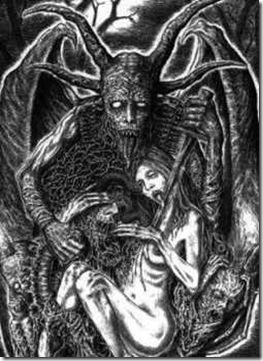
Lamashtu is a heinous, terrifying, demoness. She is said to menace women throughout and after the end of their pregnancies. She is routinely said to kidnap infants while they’re breastfeeding; she would suck their blood, and chew on their bones. Add to that the fact that her other hobbies included: Infesting rivers and lakes, killing crops and other plants, sucking the blood of men, creating sleep-disturbances, spreading diseases and illnesses, and bringing nightmares. And, unlike most demons from Mesopotamian mythology, she didn’t answer to anyone; not any god, or man, or any part of any divine hierarchy. So evil was Lamashtu, that pregnant women and their loved ones would routinely summon the demon, Pazuzu, to protect them. For the uninitiated, Pazuzu was the demon made famous by the, “The Exorcist” movies! Allegedly, Pazuzu and Lamashtu were fierce rivals, who would attack each other at any chance. While Pazuzu was known for bringing famines and droughts, soon-to-be-mothers were so afraid of Lamashtu, that they were willing to take the risk! That means that, yes, Linda Blair’s performance in “The Exorcist” was nothing compared to the wrath of Lamashtu! Lamashtu is usually described as a “mythological hybrid”, with the head of a lioness, the teeth and ears of a donkey, the feet of a bird (complete with sharp talons), as well as a hairy body, and long, sharp fingers and fingernails. She is usually depicted nursing a dog and a pig and holding snakes, while standing or kneeling on a donkey! Subtle, isn’t it?

read more...

Thursday, July 15, 2010

10 Brutal Historical Weapons of War


Today’s weapons of war are increasingly geared towards felling an enemy in as humane a way as possible, with high velocity firearms ensuring a quick death. Soldiers are also trained to kill enemies quickly and (well, almost) painlessly, with bladed side-arms. However, in times gone by, humane weapons were the last thing warriors were looking to wield. Pain and maximum suffering were the order of the day, and the popularity of a weapon could be measured by its brutality. For good reason, too! A weapon that scared the crap out of your enemy was a useful tool, as well as an empowering asset.


Let’s take a look at some of the more fearsome, and downright nasty, weapons employed by warriors of times gone by. In no particular order (I wouldn’t fancy encountering ANY of these!)


#10 - Knobkerrie

10

A knobkerrie refers to any blunt impact implement located at the end of a shaft weapon or staff. Usually a small ball of wood or metal, a knobkerrie would be used by being slammed into the nose or groin at close range. This type of weapon has been used in many different incarnations over time, but was originally used in Africa by tribal groups as a means of self defense. This weapon is still used today and can be found on the end of most hunting knives, in the form of a small ball or point of metal at the end of the handle.

Notable appearance: The Knobkerrie is employed by numerous Zulu warriors in the movie “Zulu”.

#9 - Caltrop

9

Most famously used in ninja movies, and the like, a caltrop (or caltrops) are objects with multiple sharp points, designed to be dropped when under pursuit, in order to either catch your pursuer off guard and cause nasty injury to the feet, or to force approaching enemies in to following a certain path as a trap. The primary idea behind these nasty implements is to be used as a trap which will render your foes immobile, or at least in great pain!

Notable appearance: Caltrops appear in a number of James Bond movies as a feature of Bond’s car, dropped from the vehicle to puncture the tires of pursuers.

#8 - Morning Star

8

The mace’s nastier cousin, the morning star, consists of a solid wooden or metal shaft atop which sits (in most designs) a large metal ball adorned with a number of spikes or blades. The morning star was used by infantry and horsemen, alike, in medieval times. The primary method of attack was to simply swing the weapon at your foe. The most common target was, logically, the face or head, although the blow could be directed at the legs or knees in order to disable a foe. Morning stars have returned in different forms since medieval times, and are often confused with the mace, the difference being that a mace has no spikes, instead favoring metal studs. Another form of this weapon is the well-known flail, which incorporates a chain between the shaft and spiked ball, allowing the weapon to be swung harder with less exertion.

Notable appearance: The Cave Troll appearing in The Lord of the Rings books and movies wields a huge Morning Star as his weapon of choice.


#7 - Chakram

7

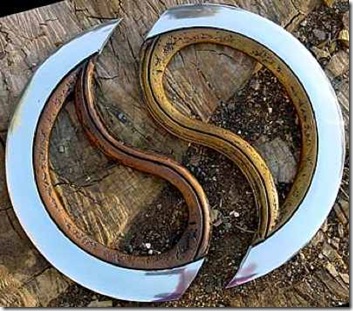
Often misidentified as a Glaive, which is actually a pole weapon similar to a pike, a Chakram is akin to a large throwing star (or shuriken). Also known as a war quoit, the weapon is of Indian origin and was usually a large bladed metal disk. Chakrams were used both for throwing, like a Frisbee, or in melee combat, where slashing was the usual method of attack. Another form of the Chakram was the Chakkar, another bladed throwing weapon in the shape of a hoop rather than a disk. Chakkars were used by Sikh warriors, again, as both a throwing and melee weapon. The weapons have a frightening range of up to 100 meters, if well manufactured.

Notable appearance: Xena, in the Xena: Warrior Princess series often uses a Chakram as a throwing weapon.

#6 - Maul

6

Similar to a modern sledgehammer, the Maul is a nasty blunt force weapon, initially appearing in use by French citizens. Mauls were not originally used particularly as a weapon, rather as tools, but in time they have been employed by various factions for combat purposes. There is no particular method for using a Maul, aside from striking almost anywhere on the body for severe damage. Common target areas would be (as is common with blunt force weapons) the head, arms or legs. A single blow from a Maul is sufficient to shatter bones and cave in skulls, even when a helmet is worn. The length of the handle allowed for the Maul to be wielded in two hands. A common tactic was to break the legs of the victim with a stout blow to the knees or shins, then finish the poor guy off with an over-head smash to the skull.

Notable appearance: Leatherface in the original Texas Chainsaw Massacre movie, uses a sledgehammer as a Maul to incapacitate one unlucky victim.


#5 - War Scythe

5

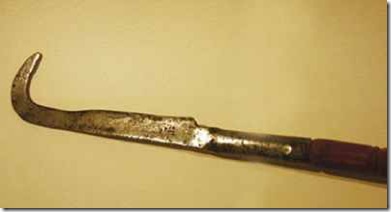
Adapted from the common farming tool, war scythes were altered so that the blade pointed straight from the top of the shaft. War scythes were used as both a slashing and a stabbing weapon, their weight and aerodynamic shape making them devastating. Capable of cutting through a metal helmet, the weapon is thought to have originated from use as an improvised weapon by peasants, which was then adapted for military use. Arguably worse than the military form, the version wielded by peasants in revolts would often be blunt from use in farming, meaning the victim was likely to survive numerous slashes before dying.

Notable appearance: The grim reaper, death himself, is usually depicted wielding a scythe type weapon.

#4 - Dragon Beard Hook

4

This nasty piece of kit was employed by Chinese warriors as a means of ensnaring and immobilizing a victim. The weapon consists of a metal head bearing two or more serrated hooks, attached to a length of rope or chain. Used by “casting” out the head, the aim was to pierce, or snag, a part of the foes body with one of the hooks, and then reel them in for the kill by pulling on the rope. This often resulted in tearing the victim’s body as they struggled to escape. Arterial damage was common and the victim was often killed by the hook itself, before they could be reeled in. The Dragon Beard Hook originates from the Song Dynasty.

Notable appearance: The Mortal Kombat character, Scorpion, uses a weapon similar to a Dragon Beard Hook to drag distant opponents into close range.


#3 - Nunchaku

3

Originating as a tool for threshing crops, nunchaku are an Okinawan weapon consisting of two lengths of wood, or sometimes metal, joined by a chain. The weapon is used by holding onto one of the wooden arms and swinging the other extremely quickly at the victim. The target area would usually be the face or arms, with the aim of breaking bones or causing blunt trauma. Nunchaku come in various flavors, ranging from the basic wooden or metal arms, to arms with attached blades or razors for extra damage. Nunchaku use is considered an art, and a skilled wielder can operate the weapon at such speed, passing from hand to hand, that they could potentially strike a victim a number of times per second. A trained user is also able to “bluff” swings, making it very difficult to defend against, since it is nearly impossible to predict where the blow will come from. Nunchaku can also be used in pairs, with one pair in each hand.

Notable appearance: Almost any martial arts movie!

#2 -Bardiche

2

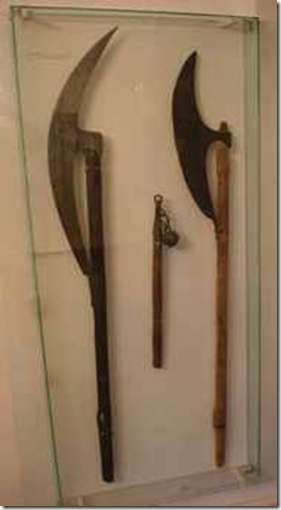
This weapon lies somewhere between a polearm and an axe (a family of weapons known as poleaxes), consisting of a long pole with a wide axe head attached along the side and tip of the shaft. The Bardiche is of Eastern European and Russian origin. Used as a slashing or cleaving weapon, the weapon was wielded in two hands and swung both horizontally and vertically. Bardiches were often wielded alongside a firearm for use in the event of close-quarters encounters, although weapons of this style were in use long before the arrival of firearms. The power of the weapon came from the weight of the blade, which was usually over 2 feet wide. The method of attack would usually consist of cleaving at the limbs or torso of the foe.

Notable appearance: Bardiche variants are often seen in fantasy and manga stories, often in the form of a giant axe with a short handle running behind the blade.


#1 -Blunderbuss

1

The only firearm to make this list, the Blunderbuss was an early form of shotgun, using powder and shot. The weapon was muzzle loaded and is identified by the distinctive flared muzzle. The nasty part of the Blunderbuss was actually a flaw in the design, the flared muzzle caused the shot to spread quite widely and reduced the muzzle velocity, meaning that shots outside of very close quarters resulted only in shrapnel wounds rather than death. A blunderbuss could, in theory, be loaded with any kind of shrapnel or shot, small stones or scraps of metal were used as ammunition at times. The gun was used by armies of various nationalities, although the weapon originates from Europe. A smaller, one handed version of the Blunderbuss, called a Dragon, was also used. Wounds sustained from a close range hit from a Blunderbuss would be brutal, potentially blowing away whole chunks of the body.

Notable appearance: Jack Sparrow, of the Pirates of the Caribbean movies, wields a handgun similar to a Dragon, while at least one member of the undead pirate crew seen in the first movie uses a Blunderbuss type firearm.

read more...

Wednesday, July 7, 2010

10 Human Creations Attributed To Aliens


Since the beginning of humanity, people have invented explanations for things they don’t understand. The culprits for the unexplained have evolved from gods and demons, to ghosts and spirits, to extraterrestrials. A recent study showed that almost 1 in 4 Americans believe that, at least some of the reported UFO’s, are actually spacecraft from other worlds. Many people believe space aliens have visited Earth in the past – if they’re not here right now. Of course the vast majority of “evidence” of extraterrestrials have simple (albeit WAY less exciting) explanations. Here are 10 man-made things falsely attributed to extraterrestrial influence. Enjoy.


#10 - Ancient Cave Paintings

10

Discoveries of ancient artwork depicting mysterious figures have helped give rise to the “Ancient Astronaut Theory”, which claims that alien beings visited prehistoric humans, possibly interacting and sharing knowledge with them. Advocates of this theory usually point to specific examples, such as a particular rock carving in the Val Camonica site in Italy, as well as the Wandjina Petroglyph (above) sites in Australia. Using these examples as evidence reaches unsturdy ground when held up to scientific scrutiny. The popular image of two “alien” figures in Val Camonica was picked out of over 200,000 drawings – a pretty clear sign of confirmation bias. Testing at the Wandjina site showed some drawings had been repainted numerous times over, with the images evolving over time at the artists’ discretion, rendering the original artwork unknown.

#9 - Egyptian Carvings

9

According to many UFO enthusiasts, the Temple of Osiris at Abydos contains definitive proof of advanced ancient technology. The glyphs seem to include depictions of a helicopter, a jet plane and some sort of flying saucer. Unfortunately for believers, the glyphs are a result of erosion and actual replacement and re-carving of hieroglyphics. The original text is part of the titulary of Seti I, that had been changed to reference Ramsses II. Modifying and defacing inscriptions was common in ancient Egypt’s history, and in this case yielded some strange-looking results. Even stranger, UFO enthusiasts do not find it odd that there are no other examples like this in the thousands of hieroglyphs discovered elsewhere, nor is there any mention of flying machines anywhere in Egyptian literature.

#8 - Nazca Lines

8

The Nazca Lines are a series of hundreds of ancient geoglyphs located in Peru. These include depictions of animals, birds, fish and humans, along with simple lines and geometric shapes. Some of them are over 600ft. across and can only be viewed properly from the air. This has led to speculation by the Ancient Astronaut crowd that the ancient Peruvians were capable of advanced flight, or were trying to communicate with beings that were. Scientists have claimed the lines were of a spiritual significance, possibly pertaining to the availability of water. Also, historians have since recreated similar lines using primitive techniques without aerial assistance.

#7 - Antikythera Mechanism

7

The Mechanism is a clock-like instrument from around 85 BC, that was discovered in 1900 near Antikythera, Greece. It was used aboard ships as a navigation tool because it could accurately predict locations of the sun, moon and the 5 known planets, at any given date. The device contained a complex system of gears, built with sophisticated technology, that rivaled that of 14th century clocks. Because of the precision involved in it’s construction, it’s almost exact predictions of cosmic bodies, and the apparent 1300 year gap in technology, UFO enthusiasts have cited this as evidence of alien contact, as humans could have never figured it’s complex technology out that early. However, if aliens were to blame, they would have probably told the Greeks about more than just five planets, or at least given them a magnetic compass. Of course ancient Greek literature mentions mechanisms like this one without mentioning other-worldly visitors.

#6 - Saqqara Bird

6

Found in a tomb excavation in 1898, the Saqqara Bird has been rumored, by believers in the Ancient Astronaut Theory, to be evidence of advanced flight in ancient Egypt. They note the vertical tail of the “bird” resembles a tailplane on an aircraft as opposed to the horizontal tail feathers of a real bird. The lack of legs, and the angle of the wings has lent to speculation about the design’s capability of aerodynamic lift. Tests performed on recreations of the artifact have shown it to have no aerodynamic properties conductive to flight. Modern scientific theories suggest it’s either a religious artifact or even just a simple children’s toy.


#5 - Dogu

5

Dogu are small humanoid figurines created in prehistoric Japan. The unusual appearance of the Dogu has been claimed to resemble some sort of space suit, supposedly complete with goggles, armor and hoses. Adding to the mystery, their exact purpose remains unclear to historians. Ancient Astronaut proponents tend to ignore the fact that the “goggle-eyed type” figures are only one of many types of Dogu, and that archaeologists have pointed out the similarity of the figure’s eyes with Inuit snow goggles. They are seldom discovered intact, with limbs having been cut or broken off. This with the exaggerated hips, buttocks, and breasts depicted suggest a possible usage in fertility rituals.


#4 - Crop Circles

4

In 1966, a man claimed to have seen a saucer shaped craft over a field near Tully, Australia. The saucer allegedly left a circular pattern of flattened reeds over the area it had taken off from. Years later, this unique story inspired two English pranksters to create their own patterns of flattened crops in local fields, using simple tools. The fad quickly spread, and crop circles became increasingly complex and intricate. While some believe this is a result of alien technology advancing, or the increasingly complex nature of an extraterrestrial “message” to humans, the overwhelming majority of crop circles have been revealed as products of deception, artistic expression and/or business or tourist interests.

#3 - Norwegian Spiral

3

In December of 2009, an enormous spiral appeared in the sky over northern Norway, leading to speculation of an extraterrestrial visit. The unusual visual phenomenon lasted for 2-3 minutes, and consisted of a blue light originating on the horizon, which gained altitude, culminating into a large white pinwheel effect before disappearing “into a wormhole.” UFO enthusiasts cited this as evidence of extraterrestrial intelligence, while the official explanation from the Russian government wasn’t quite as fantastic. Apparently, a Russian military missile test went haywire, and the spiral effect was either a result of a broken stabilizer engine, or the missile circling an airborne misfire beacon until it ran out of fuel and fell into the sea.

#2 - Stonehenge

2

With it’s enormous stones dating past 2400BC, the purpose and construction methods of Stonehenge have long been debated. Humans are generally accepted to have built the actual monument, as comparably large stones have been erected in modern times using primitive tools. However, Ancient Astronaut theorists claim that the positions of the stones confirm an ancient ability to predict eclipses. This ability would mean the ancients had knowledge of lunar nodes – the two points in space where Earth’s orbit intersects the moon’s orbit. This knowledge wouldn’t be possible without extraterrestrial influence — or by generations of astute study that was continuously passed down and improved upon. Modern science obviously leans towards the latter, but it is possible that scientists have also attributed too much astronomical meaning to the placement of the stones.

#1 - Pyramids of Giza

1

Similar to many other megalithic sites around the world, the Pyramids of Giza have been repeatedly attributed to extraterrestrials throughout the years, mostly because of the sheer magnitude of their construction. According to believers, the technology needed to build the massive monuments was not available to the Egyptians during the time they were built. The cuts and placement of the stones are said to be so precise that we cannot recreate them even in modern times. The placement of the pyramids themselves and the measurements contained within are also said to support the Ancient Astronaut Theory, such as the height of the Great Pyramid being an accurate, scaled-down measurement of the distance between Earth and the Sun, or the three Giza Pyramids correlating with the constellation Orion. Modern measuring techniques have proven hopeful ideas like those to be false, yet the rumors persist. The Pyramids of Giza do display a remarkable knowledge of engineering and measuring for their time period, but one would think that if creatures capable of interstellar travel were actually responsible for them, they would have done a better job.

Bonus - Religions

b

Believers in extraterrestrials have also pointed to religious texts to support their claims of a previous visitation. Proponents often mention the imagery in the Book of Ezekiel, or the vimanas of Hindu Vedic texts, while some religions, like Raelism and Scientology, hold the belief of extraterrestrials as basic tenets of their faith. One thing some Ancient Astronaut theorists like to mention as a modern day comparison are the so-called Cargo Cults. These “cults” arose when the primitive, indigenous populations of isolated islands were exposed to visitors from civilized countries. For example, U.S. soldiers landed on the tiny island of Tanna, Vanuatu, during WWII to build airstrips for their fight against Japan. The tribal inhabitants viewed the soldiers as gods, and accepted gifts from them as rewards from their deities. When the soldiers left as quickly as they came, the inhabitants began recreating their “rituals,” such as marching in formation and building makeshift landing strips and planes, in order to continue the delivery of their divine “cargo.” Some ufologists have speculated that ancient religions may have developed the same way, with extraterrestrials acting the part of American soldiers.

read more...

Tuesday, June 29, 2010

Top 10 Fictional Male Charmers


It’s not uncommon to find a fictional character, whether in literature, television or film, that has that certain alluring spark in his smile. He’s smooth, sophisticated, and always knows the right thing to say. And sadly, for many of us, we’ve fallen victim to his charisma. What is it about these guys that make men jealous and women weak at the knees? We’re exploring that today in our list of the top ten fictional charming men.


#10 - Sir Lancelot

10

Who is He: Sir Lancelot is one of the most celebrated knights of King Arthur’s Round Table. Now, it’s still unclear whether Lancelot was a real man or simply based on someone, but he does live abundantly through literature as a valiant and athletic hero in Arthurian legends. He and his fellow knights traveled across the lands on adventures that tested their courage, strengths and wits. Did we mention many of those stories involved damsels in distress?

How Charming is He: Most famously, Lancelot had an affair with Queen Guinevere, who was said to be one of the most beautiful women. His appeal was just too much for the married queen to handle. However, she wasn’t the only one that caught his attention. Young virgin damsels were often depicted fawning for him because he was dashing, youthful and, in many ways, perfect. Everything about him attracted women and kept his peers riddled with jealousy and admiration. In the famous poem “The Lady of Shalott” by Alfred Tennyson, she was so taken back by Lancelot that she brings on her own curse to follow him to Camelot, resulting in her death.


#9 - Han Solo

9

Who is He: If you don’t already know, you’ve been living under a rock in a galaxy far, far away. Han Solo is a mercenary from the film trilogy Star Wars. He was played by Harrison Ford, portrayed as a polar opposite of protagonist, Luke Skywalker. Han lives by his own rules, looks out for his own interests, and doesn’t give a damn if Chewbacca is shedding all over your seat. He’s Han Solo, baby and he shot first!

How Charming is He: As a rogue, Han’s charm isn’t similar to the rest of the men in our list. He’s in your face, challenging and self-serving for a good portion of the films. It’s only under the rugged exterior that the audience see the sweet, cool and bewitching aspect of the once lone wolf smuggler. In the ultimate example of his aloof slickness, Princess Leia professes her love for him and all Han has to say in response is, “I know,” and yet we still love him.

Similar Charmers: Action-adventure heroes Indiana Jones (also played by Harrison Ford) and Captain Jack Sparrow from the Pirates of the Caribbean film trilogy, played by Johnny Depp.


#8 - Dorian Gray

8

Who is He: He was the protagonist of Oscar Wilde’s novel, The Picture of Dorian Gray. He’s a man whose beauty was breathtaking, and one of the most famous examples of Adonis-like perfection in all of literature. The novel itself is a study of man’s quest for beauty and his desire for superficial excellence, demonstrated through Dorian’s wish to keep his physical appearance untainted while his portrait ages and deteriorates. Thus, his sins and transgressions never blemish his perfection, in exchange for his soul.

How Charming is He: While Dorian’s plan fails him in the end, he is still a famous charmer. Men became infatuated with his handsomeness, if only curious as to how Dorian seemed ageless, and women were unable to resist succumbing to his charms. In fact, he got every lady he desired, and broke their heart soon after. That’s just one of the perk of being the most beautiful man in literature.

Similar Charmer: Tom Jones from The History of Tom Jones, a Foundling by novelist Henry Fielding.


#7 - Ferris Bueller

7

Who is He: Ferris is the lead in the 1986 film, Ferris Bueller’s Day Off. This fourth-wall breaking character takes the day off from school to spend time in the city with his friends, while avoiding all chances of getting caught. This leads them through fun, exciting adventures as they push their luck with every new and surprising situation. Ferris, the leader and the brains behind their rowdy antics, barely keeps them out of trouble, but managed to pull off the perfect day without suffering any parental repercussions.

How Charming is He: One of the big reasons Ferris gets away with his victimless crime is his charm. He’s the cool kid in school, the kind that always seems to have a good time. He knows how to get in trouble, and how to get out of it in style. As said in the film, “Oh, he’s very popular, Ed. The sportos, the motorheads, geeks, sluts, bloods, wastoids, dweebies, dickheads – they all adore him. They think he’s a righteous dude.”


#6 -Count Dracula

6

Who is He: Count Dracula was the protagonist of Bram Stoker’s novel, Dracula. The character was based on Romanian general Vlad the Impaler, notably remembered for the cruel punishments he ordered on his enemies. Count Dracula’s notoriety surpassed the written word when he was adapted into films and television, making him one of the most famous villains, and the greatest vampire of all time (you heard me, Twihards). This powerful, enigmatic figure has been the subject of many interpretations, and still captures the interests of audiences today.

How Charming is He: For a second, look past the fact that he’s undead, he’s creepy and that he likes to drink your blood. When you study the rest of Dracula, you come to realize he’s actually a charmer (though some of you might argue he’s as charming as a snake). He possesses hypnotic eyes and mind controlling abilities, but more than that, he’s charismatic and worldly. Here’s this sophisticated being that lives like royalty, and treats his guest as such… until it’s dinner time, of course.

Similar Charmer: Patrick Bateman, from Bret Easton Ellis’s novel, American Psycho. Patrick is another dangerous and creepy character who might not traditionally be seen as a charmer, but he is when you look beyond the murder. And necrophilia. And cannibalism. No, really. He’s charming.


#5 - Jay Gatsby

5

Who is He: Jay Gatsby is a literary character from F. Scott Fitzgerald’s novel, The Great Gatsby. He’s a self made man living in the U.S. during the Jazz Age. It’s through the course of the novel that readers learn Jay earned his money through bootlegging during Prohibition, when alcohol was banned. The once former poor man is now one of the most beloved socialites of his time. He hopes his wealth and power would win the heart of Daisy, a married rich woman he has loved for years.

How Charming is He: Though his heart is set on Daisy, Jay takes all opportunities to be a good host to every one of his guests (particularly the women). He is a neat dresser, polite, fun and equipped with natural good looks. Jay is the hit of every party, and the talk of the town among the rich and powerful. Both envied and desired, Jay is often thought to be the quintessential American icon.


#4 - Rhett Butler

4

Who is He: Rhett is one of the main protagonists in Margaret Mitchell’s novel, Gone with the Wind. Clark Gable’s film portrayal brought the character to life in the 1939 movie by the same name. Rhett was considered a pariah amongst the Confederate South during the U.S.’s Civil War years. He ends up falling in love with protagonist Scarlett O’Hara, despite the fact that her heart belongs to someone else.

How Charming is He: What made Rhett different from the men around him was his experience, and sophisticated understanding of human nature. He was one of the few that appeared to be involved with the Confederate South, but still able to see it from an outsider’s perspective (ultimately keeping his distance at all times). Even as a black sheep, he was accepted by his associates for his charming ways and educated ideas. There’s just something about the mustache and smile they couldn’t seem to ignore.

Similar Charmer: Bugs Bunny. The animated rabbit is actually based on Clark Gable.


#3 - Mr. Darcy

3

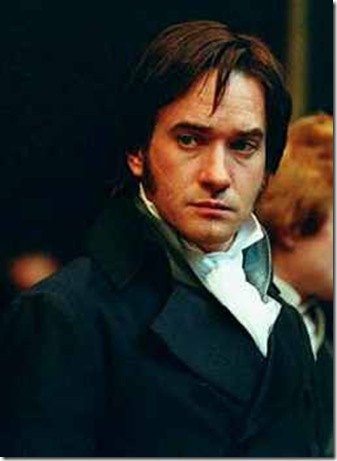
Who is He: From Jane Austen’s Pride and Prejudice, Mr. Fitzwilliam Darcy is not, at first, a charming man. He was respected by his peers for his fortune and demeanor, even if he believed himself superior to them, and acted with feigned modesty. It wasn’t until the woman he’s attracted to denied his marriage proposal that Mr. Darcy changed for the better. He saved her family from social disgrace, and redeemed himself by proving his arrogance was merely a facade.

How Charming is He: Mr. Darcy is a fangirl’s dream. He’s handsome, rich and English (it’s the accent). Most of all, he’s not just a good-looking guy. Once his perspective was changed, he became a gentleman who truly cared about others, especially Elizabeth, and who goes out of his way to validate his sincerity. There are many female readers that would openly admit to crushing on Mr. Darcy for these reasons.


#2 - Don Juan

2

Who is He: This fictional character is mostly known as a libertine, a person who disregards social norms and embodies what’s understood as loathsome and undesirable. Don Juan has been written about in a variety of stories, plays and poems but is consistently portrayed as a womanizer.

How Charming is He: There isn’t much explanation needed here. The name Don Juan itself has become a term meaning “ladies’ man.” Some of the stories glorify his actions, personifying him as a hero and revolutionary for embracing his sexuality, while other stories condemn him and his behavior as a warning to future and potential Don Juans. Either way, his charm can’t be matched easily by just any other man.


#1 - James Bond

1

Who is He: Secret Agent 007 was created by journalist Ian Fleming, and was featured in several of his novels. The character became a household name when he made the transition in to films (22 in total). These action movies were filled with dangerous car chases, explosions and beautiful women. Does any of that phase James Bond? Not likely.

How Charming is He: Bond can charm the pants off you. He is the epitome of cool, too. 007 only drives the most luxurious of cars, wears the sleekest of suits, and packs the kind of weapons and secret agent tools that make our most valued piece of technology look like a plaything. Villains hate him for his skill, women love him for his attitude and audiences adore him for his charms.

Similar Charmer: Movie character Austin Powers, who was based on James Bond.

read more...