Showing posts with label Travel. Show all posts

Monday, August 30, 2010

12 Worst Traffic Jams


1

The world's longest traffic jam was 110 miles (176 kilometers) long, between Paris and Lyon on the French Autoroute in 1980.

2

A 60-mile-long traffic jam on a major Beijing highway has lasted more than nine days, with stranded drivers taking to playing chess on their cars as local vendors organize roadside shops like in a Cortázar short story. What's causing this potentially month-long jam? In short, increased traffic on the highway mixed with maintenance and construction. Britain's Sky News reported the snarls have been commonplace since May as a result of a spike in the number of trucks using the roads, with the daily peak reaching about 17,000. In this specific case, cars and trucks have been piling up since August 14, 2010 on the National Expressway 100, which is also known as the G110, the major route from Beijing to Zhangjiakou.

3

A traffic jam in Sao Paulo, Brazil. In June 2009, Sao Paulo set a new record for bad traffic, 295km of traffic jam accumulated throughout the entire city, meaning over 35% of the city's roads.

4

Gridlock resulting from vehicles and pedestrians "blocking the box" at the intersection of 1st Avenue and 57th Street in New York City.

 5


Moscow also has different reasons for traffic jams. One of them is frosty severe winter. Transportation roads cannot work well because of black ice. The other problem is high quantity of life and, as a result, possession of many vehicles. And apparently, some streets must be reconstructed and broadened.

6

Car and Motorcycle jam in Taipei.

7

Vehicles are stuck in a traffic jam caused by a demonstration held by flood-affected people demanding that the government provide aid to flood victims in Nowshera, Pakistan.

8

Traffic jam caused by the celebration of the Diwali in North India.

9

Patna witnessed unprecedented traffic jam in December 1, 2009, following protest rallies taken out by different organizations in support of their demands. Throughout the day, traffic chaos ruled all the roads giving a tough time for commuters.

10

Another picture of Sao Paulo, at the intersection of Faria Lima and Juscelino Kubischek Avenue.

11

Frozen Traffic Jam in Moscow.

12

Traffic congestion caused by people fleeing from Houston, Texas, due to Hurricane Rita in 2005. Evacuees used Interstate 45 which was/is an official evacuation route.

read more...

Tuesday, August 24, 2010

Top 10 Unusual Islands


This is a list of islands that are somehow unusual or notable. The ranking from ten to one is somewhat arbitrary, in my opinion, since each island is unique in its own way and ratings can’t really apply (it would be kind of like asking which piece of music is better, “Stairway to Heaven” or “Eine kleine Nachtmusik”). So this one is really more like a grocery list than a “countdown from ten to one” list. The islands listed were chosen in part for their obscurity, which is why (for example) Easter Island is not on the list — everyone has heard of that one!


#10 - Ni’ihau

10

The westernmost of the eight major Hawaiian islands, Ni’ihau (pronounced NEE-ee-how) is distinct from the other seven in that it is completely privately owned, having been purchased by Elizabeth Sinclair from the Kingdom of Hawaii in 1864. Visitors are seldom permitted, hence the island’s nickname, “The Forbidden Isle”, although in recent years the island has begun to allow very limited tourism (primarily safaris). Ni’ihau has a population of about 130 people, who speak Hawai’ian as their native language (although English is also spoken).


#9 - Attu Island


9Another westernmost island, this time the westernmost in the Aleutian Islands chain in Alaska. Although Attu Island is the Aleutians’ westernmost island, it actually lies in the Eastern hemisphere. Attu has a population of twenty, all of whom live and work in Attu Station, a United States Coast Guard LORAN (Long Range Aid to Navigation) facility. Apart from being the last island in the 1,200 mile (1,900 kilometer) long Aleutian Islands chain, Attu is also distinct in that it is the location of the only land-based conflict on American soil in all of World War II.


#8 - Monuriki Island

8

Monuriki is a small, uninhabited island in the Mamanuca Island group in Fiji. Monuriki would not ordinarily be noteworthy for any particular reason, but it came into the spotlight when it was used as the primary filming location in the 2000 Tom Hanks film, “Cast Away”, about a man whose plane crashes and who, subsequently, ends up living on the island for four years. In the movie, the island is completely isolated, although in reality, there are several other islands within a few miles of it, including Tavua, with a population of some 2,400 people. Monuriki has now become a popular tourist destination due to its appearance in the film.


#7 - Navassa Island

7

Navassa is an uninhabited Caribbean island about thirty miles west of Haiti and ninety miles south of Guantanamo Bay in Cuba. Its entire coastline consists of steep cliffs, making boat landings impossible. The United States annexed it in 1857, and spent the next few decades mining its extensive guano deposits. The island is now classified as a nature reserve, requiring United States government permission (which is rarely granted) to enter. Navassa is also one of the few United States territorial disputes — it is also claimed by Haiti.


#6 - Spitsbergen

6

Spitsbergen is the largest of the Svalbard islands, north of Scandinavia. A Norwegian territory, it is home to the town of Longyearbyen, one of the world’s most northerly permanent settlements. As such, Spitsbergen contains a good deal of “world’s most northerlies”, most northerly church and most northerly airport being among them. Due to the danger of polar bears, whenever one travels anywhere on Spitsbergen outside of Longyearbyen, one is required by law to carry a rifle. Spitsbergen is also the location of the Svalbard Global Seed Vault, where a variety of plant seeds are stored for safekeeping to preserve biodiversity in case of any kind of large-scale disaster.


#5 - Palmyra Atoll

5

Palmyra is actually a collection of small islets, located roughly halfway between Hawaii and Samoa. The largest, Cooper Island, is privately owned and administered by The Nature Conservancy. The rest is owned by the United States federal government and is administered by its Fish and Wildlife Service. Palmyra is staffed by a small group of government scientists and Nature Conservancy volunteers for preservation and research. In 1974, Palmyra was the location of a double murder, later detailed in Vincent Bugliosi’s best selling true crime book, “And the Sea Will Tell”.


#4 - Howland Island

4

Howland lies about halfway between Hawaii and Australia, and is only about fifty miles north of the equator. Like many small Pacific islands, it was claimed by the United States and mined for its guano deposits. There was also an attempt at colonization, but it was interrupted by World War II, when Howland was attacked by Japanese bombers the day after Pearl Harbor was bombed, killing two of the colonists and requiring the other two to be evacuated. No further attempt at colonization was made after the war. Howland is now a nature preserve and is probably best known for being the stop on Amelia Earhart’s around-the-world flight at which she never arrived.


#3 - Pitcairn Island

3

Pitcairn is the only inhabited island of the four in the Pitcairn Islands group. It is the last remaining British overseas territory in the Pacific. Pitcairn Island, with only fifty or so inhabitants, is the least populous and most remote jurisdiction in the world (being some 1300 miles, or 2100 kilometers, west of Chile). All of its inhabitants are descendants of the mutineers from the HMS Bounty and the Polynesians who accompanied them. The burned wreckage of the Bounty is still visible under the waters of Bounty Bay. Pitcairn makes what is supposedly some of the best honey in the world, so much so that even the Queen has praised its virtues. If you decide to buy some through their web site, though, be prepared for a long wait. Pitcairn has no airport, and Bounty Bay is small and shallow, so the island is visited and supplied only occasionally. Mail deliveries can be months apart. (I ordered some honey myself about two or three months ago and am told that it will still be about another month before it even gets off the island.) Pitcairn is unique in quite a few other ways as well, so much so that I had a hard time deciding which ones to include and which to leave out!


#2 - Bouvet Island

2

Bouvet is a 19 square mile (49 square kilometer) volcanic island in the South Atlantic Ocean, about 1550 miles (2500 kilometers) south-southwest of South Africa. It is almost completely covered with ice. Most of the coastline consists of very steep cliffs, making landings difficult. Bouvet was originally a British territory, but Britain waived its claim and ceded the island to Norway, which maintains it today as a nature preserve. Bouvet has never been inhabited and almost certainly never will be, but it still has its own top-level Internet domain name, .bv, which is unused. Bouvet’s claim to fame is that it is the most remote island in the world. The nearest land, Queen Maud Land in Antarctica, lies some 1,100 miles (1,750 kilometers) to the south. Adventure travelers and amateur radio operators (using the island-specific prefix 3Y) therefore like to travel there.


#1 - North Sentinel Island

1

North Sentinel Island lies some 20 miles (32 kilometers) west of Smith Island, in the Bay of Bengal. It is about 28 square miles (72 square kilometers) and is completely forested, with the exception of the thin strips of beach that encircle most of it. It is otherwise unremarkable, except that it is populated by one of the few remaining “uncontacted peoples” in the world. The Sentinelese are highly xenophobic and resist virtually all attempts at contact, frequently firing arrows at boats and helicopters that come too close to the island (sometimes killing the “intruders). Between their active isolationism and the difficulty of observing the island from the air, almost nothing is known of the Sentinelese — their language, culture, and even an accurate estimation of their numbers are all unknown. North Sentinel Island is technically part of the Andaman and Nicobar Islands Union Territory, but in practice, the local government has said that they intend to leave the island to its inhabitants, making it de facto autonomous.

read more...

Sunday, August 15, 2010

10 Sayings and their Strange Origins


This is a list of phrases we are all familiar with and most likely use from time to time. The origins of these phrases are often unexpected and strange. As you will see on this list, some of them originate in places you simply wouldn’t believe.


#10 - Always a Bridesmaid, Never a Bride

10

This phrase, surprisingly, was used to sell Listerine mouthwash! To promote their product, the manufacturers of Listerine employed the personal experience of girls at the time, who desperately wanted to settle down but seemed always to be left on the shelf. First used in the 1920’s, it portrays a situation and a possible explanation for the lack of success these girls had. Here is the transcript of the ad:

Poor Edna was getting on for thirty and most of her girlfriends were either already married, or about to tie the knot. How she wished that, instead of being their bridesmaid, she could be the bride! However, any romance of hers invariably ended quickly. There was a reason. Unbeknownst to her, she suffered from bad breath and no one would tell her, not ever her closest friends. The advertisement sold millions of bottles of mouthwash and also gave the English language a new saying!


#9 - Bark up the wrong tree

9

Originating back when hunting was still a major sport, this phrase came from when animals were used to track, catch or retrieve prey. This applies, not least, to dogs. Dogs were used in the chasing of raccoons, which was chiefly undertaken at night and were trained to indicate the tree in which the animal had taken refuge by barking at it. Of course, even dogs can err and, at times, barked up the wrong tree.


#8 - Be on a good footing

8

A pleasant relationship with other people, not least those in a superior position, is portrayed as being ‘on a good footing’ with them. There are two thoughts as to where this saying came from. Some say the phrase goes back to a practice of early apprenticeships. It was the custom, on the first day at work, for apprentices to invite all their workmates for drinks. The new apprentice ‘footed the bill’. If proved a generous host, he made friends for keeps. The hospitality would never be forgotten. Recalling how much it had cost, it was said the novice gained ‘a good footing’. A second derivation links the phrase with an early and bizarre interpretation of human anatomy, the importance given to the length of one of a person’s digits. At one time, the dimension of the middle toes determined a person’s ‘standing’ in the community. Thus, the measurement of their foot decided their status in the eyes of others. Those whom nature and genes had endowed with large feet were lucky to be ‘on a good footing’. Draw your own conclusions on this one!


#7 - Beat around the bush

7

Someone who doesn’t get to the point is said to ‘beat around the bush’. The origin of this phrase is, undoubtedly, from hunting, and more specifically from the hunting of boars. A ferocious animal, it often hid in the undergrowth and beaters were employed and ordered to go straight in to chase it out. But very much aware, and afraid, of the animals’ sharp tusks, they much preferred to merely ‘beat around the bush’ a practice strongly disapproved of by their masters.


#6 - Best foot forward

6

When you are trying to make a good impression it is said that you should put your ‘best foot forward’. There are many options as to where this phrase came from, one being that it was believed that ‘the left’ was the realm of the devil, of evil and misfortune. After all the Latin word sinister means left, and in English sinister has kept its ominous meaning. Hence, it was advisable to keep the left foot behind and step forward with the best, the right, foot first.

But this phrase seems to have come from the fashion world, rather than the occult. The saying can be traced to male vanity, particularly apparent in the late eighteenth century, the period of the dandy. His desire to attract people’s attention and admiration took strange and elaborate forms. At the time, people imagined that their two legs differed in shape and that ‘normally’ one was more becoming than the other. To draw attention to it they kept the worse one in the background, literally putting ‘their best foot forward’, and with it, of course, their leg.


#5 - Bite the bullet

5A person who ‘bites the bullet’, without any sign of fear, acts with great courage in the face of adversity. The phrase recollects a dangerous army practice in the 1850s. Soldiers were then equipped with the British Enfield rifle. Prior to using it, they had to bite off the head of the cartridge to expose the explosive to the spark which would ignite it. The procedure was fraught with danger, particularly so in the heat of battle. It needed firmness and courage, as even the slightest deviation or hesitation would endanger the soldier.


#4 - Blow Hot and Cold

4

People who waver in their opinions and quickly change from being enthusiastic to showing disinterest are said to ‘blow hot and cold’. The saying can be traced to one of Aesop’s Fables. It was a cold winter’s day, and the freezing traveler was blowing on his stiff fingers. Mystified, a satyr wanted to know what he was doing. The man explained to him that, with his breath, he was warming his chilled fingers. Taking pity on him, the satyr invited the man to his home for a hot meal. This time, he watched him blowing on the food, which intrigued him all the more. Inquiring why he did so, his guest explained that he was blowing on the stew to cool it down. There and then the satyr told the traveler to leave at once. He was not prepared to entertain, or even mix with, someone who could ‘blow hot and cold from the same mouth’.


#3 - Break a leg

3

To wish an actor prior to his going on stage to ‘break a leg’ is a well-known practice. A pretty strange wish, actually it is meant magically to bring him luck and make sure that his performance will be a success. From the superstitious age it was thought that jealous forces, always present, are only too anxious to spoil any venture. A good luck wish would alert and provoke them to do their evil work, whilst a curse will make them turn their attention elsewhere. The underlying principle is the belief that if you wish evil, then good will come. I’m sure it’s called reverse psychology these days.


#2 - Bury the hatchet

2

To bury the hatchet means to create peace. With hostilities at an end, the hatchet was no longer needed, and therefore could be disposed of. Now a merely figurative expression, the phrase is based on an actual practice of North American Indians. When negotiating peace, they buried all their weapons; their tomahawks, scalping knives and clubs. Apart from showing their good faith, simultaneously it made it impossible for them to go on fighting.


#1 - By hook or by crook

1

The achievement of a goal with determination, by fair means or foul, is described as getting things done ‘by hook or by crook’. The origin of this phrase is linked with an early British practice, at a time when forests were still the exclusive property of royalty. For any unauthorized commoner, then, to gather firewood in them was a crime, poor people being the only exception. Though they were not permitted to cut or saw off branches, they were free to remove withered timber from the ground or even a tree, doing so by means of either a hook or a crook.

read more...

Thursday, July 15, 2010

10 Brutal Historical Weapons of War


Today’s weapons of war are increasingly geared towards felling an enemy in as humane a way as possible, with high velocity firearms ensuring a quick death. Soldiers are also trained to kill enemies quickly and (well, almost) painlessly, with bladed side-arms. However, in times gone by, humane weapons were the last thing warriors were looking to wield. Pain and maximum suffering were the order of the day, and the popularity of a weapon could be measured by its brutality. For good reason, too! A weapon that scared the crap out of your enemy was a useful tool, as well as an empowering asset.


Let’s take a look at some of the more fearsome, and downright nasty, weapons employed by warriors of times gone by. In no particular order (I wouldn’t fancy encountering ANY of these!)


#10 - Knobkerrie

10

A knobkerrie refers to any blunt impact implement located at the end of a shaft weapon or staff. Usually a small ball of wood or metal, a knobkerrie would be used by being slammed into the nose or groin at close range. This type of weapon has been used in many different incarnations over time, but was originally used in Africa by tribal groups as a means of self defense. This weapon is still used today and can be found on the end of most hunting knives, in the form of a small ball or point of metal at the end of the handle.

Notable appearance: The Knobkerrie is employed by numerous Zulu warriors in the movie “Zulu”.

#9 - Caltrop

9

Most famously used in ninja movies, and the like, a caltrop (or caltrops) are objects with multiple sharp points, designed to be dropped when under pursuit, in order to either catch your pursuer off guard and cause nasty injury to the feet, or to force approaching enemies in to following a certain path as a trap. The primary idea behind these nasty implements is to be used as a trap which will render your foes immobile, or at least in great pain!

Notable appearance: Caltrops appear in a number of James Bond movies as a feature of Bond’s car, dropped from the vehicle to puncture the tires of pursuers.

#8 - Morning Star

8

The mace’s nastier cousin, the morning star, consists of a solid wooden or metal shaft atop which sits (in most designs) a large metal ball adorned with a number of spikes or blades. The morning star was used by infantry and horsemen, alike, in medieval times. The primary method of attack was to simply swing the weapon at your foe. The most common target was, logically, the face or head, although the blow could be directed at the legs or knees in order to disable a foe. Morning stars have returned in different forms since medieval times, and are often confused with the mace, the difference being that a mace has no spikes, instead favoring metal studs. Another form of this weapon is the well-known flail, which incorporates a chain between the shaft and spiked ball, allowing the weapon to be swung harder with less exertion.

Notable appearance: The Cave Troll appearing in The Lord of the Rings books and movies wields a huge Morning Star as his weapon of choice.


#7 - Chakram

7

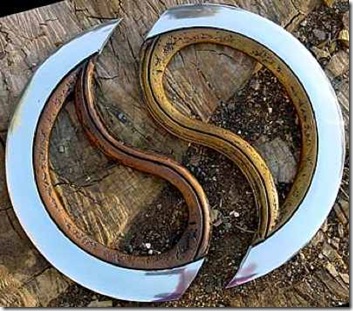
Often misidentified as a Glaive, which is actually a pole weapon similar to a pike, a Chakram is akin to a large throwing star (or shuriken). Also known as a war quoit, the weapon is of Indian origin and was usually a large bladed metal disk. Chakrams were used both for throwing, like a Frisbee, or in melee combat, where slashing was the usual method of attack. Another form of the Chakram was the Chakkar, another bladed throwing weapon in the shape of a hoop rather than a disk. Chakkars were used by Sikh warriors, again, as both a throwing and melee weapon. The weapons have a frightening range of up to 100 meters, if well manufactured.

Notable appearance: Xena, in the Xena: Warrior Princess series often uses a Chakram as a throwing weapon.

#6 - Maul

6

Similar to a modern sledgehammer, the Maul is a nasty blunt force weapon, initially appearing in use by French citizens. Mauls were not originally used particularly as a weapon, rather as tools, but in time they have been employed by various factions for combat purposes. There is no particular method for using a Maul, aside from striking almost anywhere on the body for severe damage. Common target areas would be (as is common with blunt force weapons) the head, arms or legs. A single blow from a Maul is sufficient to shatter bones and cave in skulls, even when a helmet is worn. The length of the handle allowed for the Maul to be wielded in two hands. A common tactic was to break the legs of the victim with a stout blow to the knees or shins, then finish the poor guy off with an over-head smash to the skull.

Notable appearance: Leatherface in the original Texas Chainsaw Massacre movie, uses a sledgehammer as a Maul to incapacitate one unlucky victim.


#5 - War Scythe

5

Adapted from the common farming tool, war scythes were altered so that the blade pointed straight from the top of the shaft. War scythes were used as both a slashing and a stabbing weapon, their weight and aerodynamic shape making them devastating. Capable of cutting through a metal helmet, the weapon is thought to have originated from use as an improvised weapon by peasants, which was then adapted for military use. Arguably worse than the military form, the version wielded by peasants in revolts would often be blunt from use in farming, meaning the victim was likely to survive numerous slashes before dying.

Notable appearance: The grim reaper, death himself, is usually depicted wielding a scythe type weapon.

#4 - Dragon Beard Hook

4

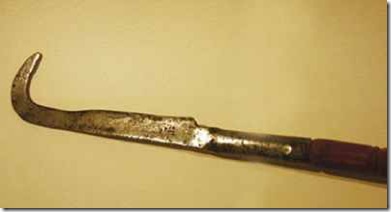
This nasty piece of kit was employed by Chinese warriors as a means of ensnaring and immobilizing a victim. The weapon consists of a metal head bearing two or more serrated hooks, attached to a length of rope or chain. Used by “casting” out the head, the aim was to pierce, or snag, a part of the foes body with one of the hooks, and then reel them in for the kill by pulling on the rope. This often resulted in tearing the victim’s body as they struggled to escape. Arterial damage was common and the victim was often killed by the hook itself, before they could be reeled in. The Dragon Beard Hook originates from the Song Dynasty.

Notable appearance: The Mortal Kombat character, Scorpion, uses a weapon similar to a Dragon Beard Hook to drag distant opponents into close range.


#3 - Nunchaku

3

Originating as a tool for threshing crops, nunchaku are an Okinawan weapon consisting of two lengths of wood, or sometimes metal, joined by a chain. The weapon is used by holding onto one of the wooden arms and swinging the other extremely quickly at the victim. The target area would usually be the face or arms, with the aim of breaking bones or causing blunt trauma. Nunchaku come in various flavors, ranging from the basic wooden or metal arms, to arms with attached blades or razors for extra damage. Nunchaku use is considered an art, and a skilled wielder can operate the weapon at such speed, passing from hand to hand, that they could potentially strike a victim a number of times per second. A trained user is also able to “bluff” swings, making it very difficult to defend against, since it is nearly impossible to predict where the blow will come from. Nunchaku can also be used in pairs, with one pair in each hand.

Notable appearance: Almost any martial arts movie!

#2 -Bardiche

2

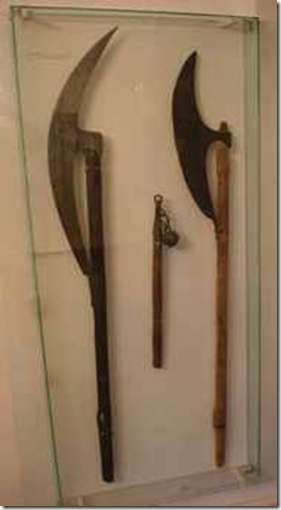
This weapon lies somewhere between a polearm and an axe (a family of weapons known as poleaxes), consisting of a long pole with a wide axe head attached along the side and tip of the shaft. The Bardiche is of Eastern European and Russian origin. Used as a slashing or cleaving weapon, the weapon was wielded in two hands and swung both horizontally and vertically. Bardiches were often wielded alongside a firearm for use in the event of close-quarters encounters, although weapons of this style were in use long before the arrival of firearms. The power of the weapon came from the weight of the blade, which was usually over 2 feet wide. The method of attack would usually consist of cleaving at the limbs or torso of the foe.

Notable appearance: Bardiche variants are often seen in fantasy and manga stories, often in the form of a giant axe with a short handle running behind the blade.


#1 -Blunderbuss

1

The only firearm to make this list, the Blunderbuss was an early form of shotgun, using powder and shot. The weapon was muzzle loaded and is identified by the distinctive flared muzzle. The nasty part of the Blunderbuss was actually a flaw in the design, the flared muzzle caused the shot to spread quite widely and reduced the muzzle velocity, meaning that shots outside of very close quarters resulted only in shrapnel wounds rather than death. A blunderbuss could, in theory, be loaded with any kind of shrapnel or shot, small stones or scraps of metal were used as ammunition at times. The gun was used by armies of various nationalities, although the weapon originates from Europe. A smaller, one handed version of the Blunderbuss, called a Dragon, was also used. Wounds sustained from a close range hit from a Blunderbuss would be brutal, potentially blowing away whole chunks of the body.

Notable appearance: Jack Sparrow, of the Pirates of the Caribbean movies, wields a handgun similar to a Dragon, while at least one member of the undead pirate crew seen in the first movie uses a Blunderbuss type firearm.

read more...

Wednesday, July 7, 2010

10 Most Terrifying Places on Earth


There are places on this planet that are stranger than the most alien landscapes we have ever imagined. Places that make your skin crawl. Places that induce heavy breathing and paranoia, before anything has even happened. We walk the dark, dusty steps of old castles and houses. We roam the halls of asylums and tunnels, hoping to glimpse something otherworldly. But sometimes, we wish we wouldn’t. Sometimes, our curiosity gets the better of us in the beginning, and is then squashed by a feeling that no human ever wants to be familiar with: absolute terror.

We hear screams in the night, footsteps in the hall. We see shadows flit by, and fog taking the shape of something eerily familiar. We breathe, we pray, and step lightly. We scream, we curse, and we sprint. Some encounters are mysterious, others violent, all terrifying. Why do we insist on investigating places such as these? Mere curiosity only gets us so far, and then we need a driving force embedded much deeper into our psyche in order to power on. Would you spend the night alone in these places?


#10 - Riddle House

10

The History

The Riddle House in Palm Beach County, Florida, was originally a funeral parlor. The Victorian house was dismantled and rebuilt in Yesteryear Village at the South Florida fair grounds. In the 1920’s the house became privately owned by Karl Riddle.

The Terror

Joseph, one of Riddle’s former employees, committed suicide by hanging himself in the attic of the house. Joseph, for whatever reason, hated men, and displays this hatred by attacking men who enter the attic. One man had a lid flung at his head, and men are now no longer allowed in the attic. Other places in the house are haunted as well, with furniture being frequently moved.


#9 - Helltown
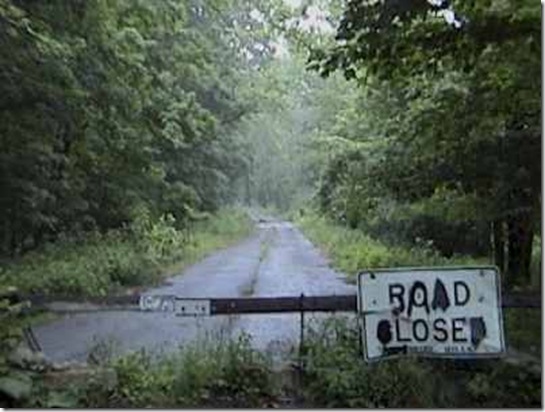
9

The History

The Northern part of Summit County in Ohio is known by the eerily blunt moniker, Helltown. In the 70’s, Boston Township was the site of a government buyout, and subsequent mass eviction of citizens. The houses were intended to be torn down and the land used for a national park, but the plans never quite manifested. Legends spawned wildly, and who can blame the legend mongers? Driving through the dark, wooded landscape was enough to give you chills even when it was populated, let alone when you have to drive by boarded up houses standing next to the burnt out hulks of others (the local fire department used some buildings for practice).

The Terror

Whether based on a kernel of truth or cooked up in the heads of creative visitors, the persistent legends of Helltown add to the creep factor. The steep Stanford Road drop off, immediately followed by a dead end, is aptly named The End of the World. If you get stuck at this dead end for too long, according to ghost story enthusiasts, you may meet your end at the hands of many members of the endless parade of freaks patrolling the woods. Satanists, Ku Klux Klan members, an escaped mental patient, an abnormally large snake, and mutants caused by an alleged chemical spill proudly march in this parade. And if you stray from the roads, you may find Boston Cemetery, home to a ghostly man, grave robbers, and the quirkiest of all, a moving tree.


#8 - Stull Cemetery


The History

Stull, Kansas, is a tiny, unincorporated town in Bumfuck, Nowhere- er, pardon, Douglas County. Ten miles west of Lawrence and thirteen miles east of Topeka puts it far from anything resembling a large population center. The population of Stull is approximately 20 people. But, don’t let the deceptively quaint village fool you. A darker side lurks behind the bushes and in the shadows.

The Terror

In the early 20th century, two tragedies rocked the tiny settlement (please observe, these are not legend or folklore, but fact). First, a father finished burning a farm field, only to find the charred corpse of his young son in the aftermath. The second incident to occur was a man went missing, and was later found hanged from a tree. As far as legends go, the infamous cemetery is where you can find your fill of supernatural lore. The book Weird US has this to say on Stull Cemetery:

“There are graveyards across America that go beyond merely being haunted and enter into the realm of the diabolical. They are places so terrifying that they say the devil himself holds courts with his worshippers there. The cemetery on Emmanuel Hill in Stull, Kansas, is one of these places.”

Rumors exist stating that Stull Cemetery is one of the 7 gateways to Hell. While the old church is now demolished, many attempt to sneak in at night for a peek at the unsavory goings-on. But be warned, the police patrol heavily, especially on Halloween and the spring equinox. The place is supposed to be so unholy, in fact, that some claim Pope John Paul II refused to allow his plane to fly over eastern Kansas, on his way to an appearance in Colorado. The validity of this last claim is up for debate, but none can deny that legends or not, Stull Cemetery is a terrifying place to be.


#7 - The Ridges


The History

Originally known as the Athens Lunatic Asylum, The Ridges was renamed after the state of Ohio acquired the property. The hospital saw hundreds of lobotomies, and often declared masturbation and epilepsy to be the causes of insanity in patients.

The Terror

Athens, Ohio, is listed as the 13th most haunted place in world as per the British Society for Psychical Research. The nearby Ohio University (which currently owns most of the property on which the Ridges is located) is said to be heavily haunted. The notorious rapist with Dissociative Identity Disorder, Billy Milligan, was housed at the facility for years. The most famous story, however is that of a 54 year old female patient who ran away and was missing for 6 weeks. She was found dead in an unused ward. She had taken off all of her clothes, neatly folded them, and laid down on the cold concrete where she subsequently died. Through a combination of decomposition and sun exposure, her corpse left a permanent stain on the floor, which is still visible today. Her spirit now haunts the abandoned ward.


#6 - Humberstone and LaNoria
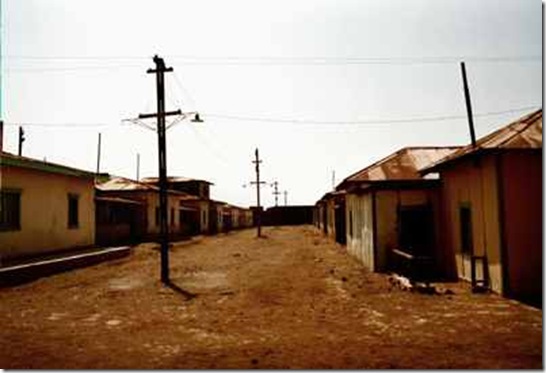
6

The History

These two abandoned mining towns in Chile were recently featured on an episode of the SyFy Channel’s show, Destination Truth. In 1872, the town was founded as a saltpeter mine, and business boomed. However, after several heavy blows (including the Great Depression), the business declined and then collapsed in 1958, and the town of Humberstone and it’s surrounding towns were abandoned by 1960. Treatment of workers in both towns bordered on slavery, and now the towns are left standing derelict.

The Terror

It is rumored that the dead of the La Noria cemetery rise at night and walk around the town, and ghostly images frequently show up in photographs in Humberstone. These towns are so terrifying, the residents of nearby Iquique refuse to enter them. The former residents never left, and can be seen walking around, and children have been heard playing. The cemetery of La Noria, regardless of whether it’s occupants actually walk at night, contains opened graves where the bodies are fully exposed, leaving you to wonder why. Is ghosts, or is it grave robbers? As if either prospect is very appealing.

Full episodes of Destination Truth, including the episode featuring Humberstone and La Noria, can be seen here.


#5 - Byberry Mental Asylum


The History

The Philadelphia State Hospital at Byberry, or known simply as Byberry, was the poster image for patient maltreatment. The hospital, in it’s most popular form, was founded in 1907 and known as the Byberry Mental Hospital. It exceeded it’s patient limit quickly, maxing out at over 7,000 in 1960. It housed everything from the mentally challenged to the criminally insane. Due to it’s atrocious conditions, and the sub-human treatment of it’s patients, the hospital was closed and abandoned in 1990. It had since become a nuisance for the neighborhood, as it was a breeding ground for vandals, arsonists, Satanists, and urban explorers. It was demolished in 2006, in spite of the fear of spreading asbestos, (which is what kept it standing for 16 years).

The Terror

The terrifying aspect of this location isn’t so much it’s hauntings or the unsavory characters that lurked after dark (although you would have been wise to be wary of both while exploring the building). The terror here comes from the facts of the how the hospital was run. Human excrement lined the hallways, which were also where many patients slept. The staff was abusive, and frequently exploited and harassed patients. One patient had a tooth pulled without Novocaine, while another killed and dismembered a female patient. Although the killer, Charles Gable, was never found, the victim’s body was found strewn across the property. Her teeth were found being played with by another patient. Even as the hospital was in the process of closing, two released patients were found dead in the Delaware River, two successive days after their release. Perhaps that gate in Stull Cemetery opens here.


#4 - Leap Castle


The History

While this Irish castle is perhaps the most popular location featured on the list, it is worth recapping the long and often gruesome history. Although it was built by the O’Bannons in the late 15th century, the castle was taken over by the ruling O’Carrolls, to whom the O’Bannons were subject. After the death of Mulrooney O’Carroll, a fierce rivalry erupted, culminating in two brothers struggling for control. One of the brothers, a priest, was brutally murdered in his own chapel, in front of the family, by the other brother. This chapel is now know as the Bloody Chapel, for obvious reasons. Many people were held prisoner and even executed at the castle.

The Terror

The castle is rumored to be haunted by a vast number of spirits, including a violent, hunched beast known only as the Elemental. It is most recognizable by the accompanying smell of rotting flesh and sulphur. While renovating the castle, workers discover an oubliette, which is a dungeon accessible only through a ceiling hatch, into which prisoners are thrown, then forgotten and left to die. This particular oubliette contained three cartloads of human remains, and was filled with spikes to impale those thrown into it’s depths.


#3 - Shades of Death Road
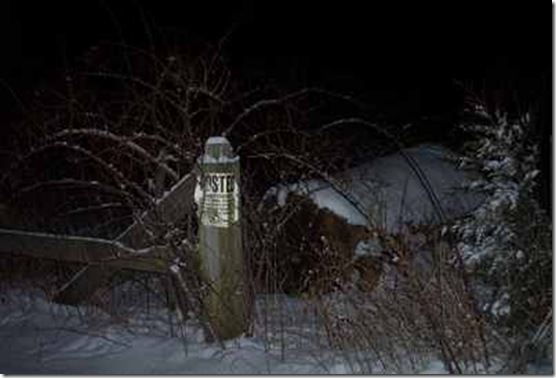
3

The History

This New Jersey road winds through 7 miles of countryside, and along that stretch it gives us no definitive clues as to the origin of it’s eerie name (for those wondering, Shades of Death is not a nickname given by locals, but is in fact the road’s official moniker). While the explanation for this highly unusual name has been lost, many theories abound. Some say that murderous highwaymen would rob and kill those along the road. Others say the reason was because of violent retaliations by the locals against the very same highwaymen, resulting in their lynched corpses being hung up as a warning. Some attribute it to three murders that occurred in the 20’s and 30’s. The first murder saw a robber beating his victim over the head with a tire iron, the second saw a woman decapitate her husband and bury the head and body on separate sides of the road, and the third consisted of poor Bill Cummins being shot and buried in a mud pile. Some attribute it to massive amounts of fatal car crashes, while others consider it the fault of viscous wildcats from the nearby Bear Swamp. The most likely explanation, however, is that malaria-bearing mosquitos terrorized the locals year to year, and the remoteness of the area prevented good medical attention from being prominent in the area. This is supported by the fact that, in 1884, most of the swamps in the area were drained.

The Terror

Gruesome history and spooky name aside, you have much to fear along this byway. South of the I-80 overpass lies an officially unnamed lake, that most will tell you is called Ghost Lake. This lake is frequently the home of specter-like vapors, and the sky is supposed to be unusually bright, no matter what time of night you are there. As per the name, ghosts of the highwaymen’s victims roam the area, and they are most frequent in the abandoned cabin across the lake. The dead-end road known as Lenape Lane is home to thick fogs and apparitions, you may be chased off the road by a white light. I’ll let Wikipedia detail the most disturbing aspect of the road:

“One day during the 1990s, some visitors found hundreds of Polaroid photographs scattered in woods just off the road. They took some and shared them with Weird NJ, which published a few as samples. Most of the disturbing images showed a television changing channels, others showed a woman or women, blurred and somewhat difficult to identify, lying on some sort of metal object, conscious but not smiling. Local police began an investigation after the magazine ran an item with the photos, but the remainder disappeared shortly afterwards.”


#2 - Tuol Sleng Genocide Museum


The History

Welcome to Phnom Penh, Cambodia, home of the Tuol Sleng Genocide Museum. This former high school was converted, in 1975, to Security Prison 21 by the Khmer Rouge. The prison was used as a base to torture and murder prisoners. Most of the prisoners were former soldiers and government officials from the Lon Nol regime. However, the Khmer Rouge leaders’ paranoia soon caught up with them, and they began shipping people from their own ranks to the prison. Many prisoners were tortured and tricked into naming their family and associates, who were them also arrested, tortured and murdered.

The Terror

The ghosts of the estimated 17,000 victims of Tuol Sleng continue to roam the halls, and odd happenings around the place are often attributed to them. And it isn’t hard to see why. Most were forced to confess to crimes they didn’t actually commit. Although most victims were Cambodians, many foreigners fell victim to the death machine, including Americans, French, a New Zealander, a Briton, Australians, Arabs, Indians, Pakistanis and Vietnamese. Only 12 people are thought to have survived. To close this entry on the sad history, I’ll leave you with the actual security regulations, the ten rules all prisoners had to abide by. All imperfect grammar is said in context due to poor translation.

1. You must answer accordingly to my question. Don’t turn them away.
2. Don’t try to hide the facts by making pretexts this and that, you are strictly prohibited to contest me.
3. Don’t be a fool for you are a chap who dare to thwart the revolution.
4. You must immediately answer my questions without wasting time to reflect.
5. Don’t tell me either about your immoralities or the essence of the revolution.
6. While getting lashes or electrification you must not cry at all.
7. Do nothing, sit still and wait for my orders. If there is no order, keep quiet. When I ask you to do something, you must do it right away without protesting.
8. Don’t make pretext about Kampuchea Krom in order to hide your secret or traitor.
9. If you don’t follow all the above rules, you shall get many many lashes of electric wire.
If you disobey any point of my regulations you shall get either ten lashes or five shocks of electric discharge.


#1 - The Mines of Paris


The History

The seemingly infinite tunnels that run below the streets of Paris should not be confused with Catacombs of Paris, the famous underground ossuary, although the mines are also mistakenly referred to as the catacombs. Exploring the mines is illegal, and penalties include heavy fines. The mines were used to dig out minerals from Paris’ varied sediment (the location where Paris is was submerged for millions of years), and the tunnels are what got left behind.

The Terror

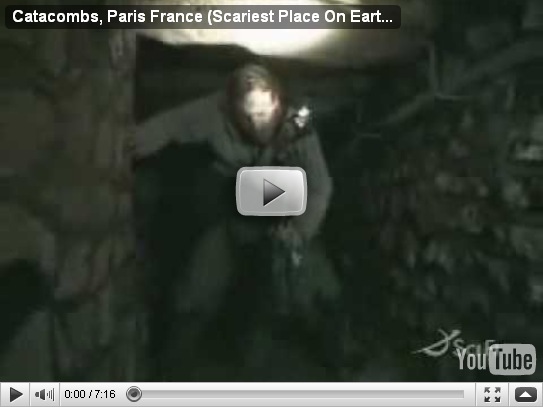
The mines are now unkempt, unpatrolled, and unsafe. As far as legends go, ancient cults and creatures patrol the depths. Spirits dwell in the infinite shadows, and if one wanders deep enough, and survives, they may even enter Hades itself. As far as reality goes, those legends can take a back seat. The tunnels stretch for close to 600 kilometers throughout the Parisian underground, and most of them are unmapped. Saying it is easy to get lost is an understatement. It is nearly impossible not to get lost. Many parts of the catacombs are hundreds of feet below street level. Some hallways are flooded, or are so narrow you have to crawl through them. There are holes that drop hundreds of feet, and manholes that are unreachable, luring unwary urban explorers in with false promises of freedom. The infinite underground maze absorbs sound, mutes it, making it unlikely you will hear somebody yelling for help, even if they are not far away. Or, worse yet, making it unlikely somebody will hear you. Thousands of human bones litter the tunnels, due to overcrowding in many of Paris’ cemeteries. Weird paintings adorn the walls. Are they ancient? Are they new? Are they warnings? Or pleas for help? If you have claustrophobia, you will want to avoid the mines at all costs. If you don’t have claustrophobia, you probably will after a trip through the mines. Bring plenty of batteries, backup flashlights, clean water, a friend, and say a prayer before entering the mines of Paris. You will need them all.

read more...